What to see in zurich old town (and how to see it in one day)
If you’re asking what to see in zurich old town, you want a clear plan that fits into a single day: churches with iconic stained glass, riverfront alleys, a hillside viewpoint, the town hall, and easy moments by the lake. Zurich’s Altstadt sits on both sides of the Limmat, from Central down to Bürkliplatz, and it’s compact enough to walk. The official city guide gives a solid overview of the core sights, lanes, and squares you’ll pass on this route. Open the Zurich Old Town overview.
Route at a glance: begin at the train station (Zürich HB), climb to Lindenhof for the classic postcard view, drop to St. Peter and Fraumünster, cross Münsterbrücke to Grossmünster, wander Niederdorf and Schipfe, peek at the Rathaus and Helmhaus, then drift to the lake and end by the opera house at Sechseläutenplatz. You’ll touch every must-see without racing.
Lindenhof: the green hill that explains the city
Five minutes from the station, a short climb leads to Lindenhof. This leafy terrace is where Zurich began—first a Roman fort, later a Carolingian royal residence—and today it’s the best free panorama over the Old Town, the Limmat, and church towers. Look down to the wooden-fronted houses of Schipfe on the riverbank; you’ll walk there next.
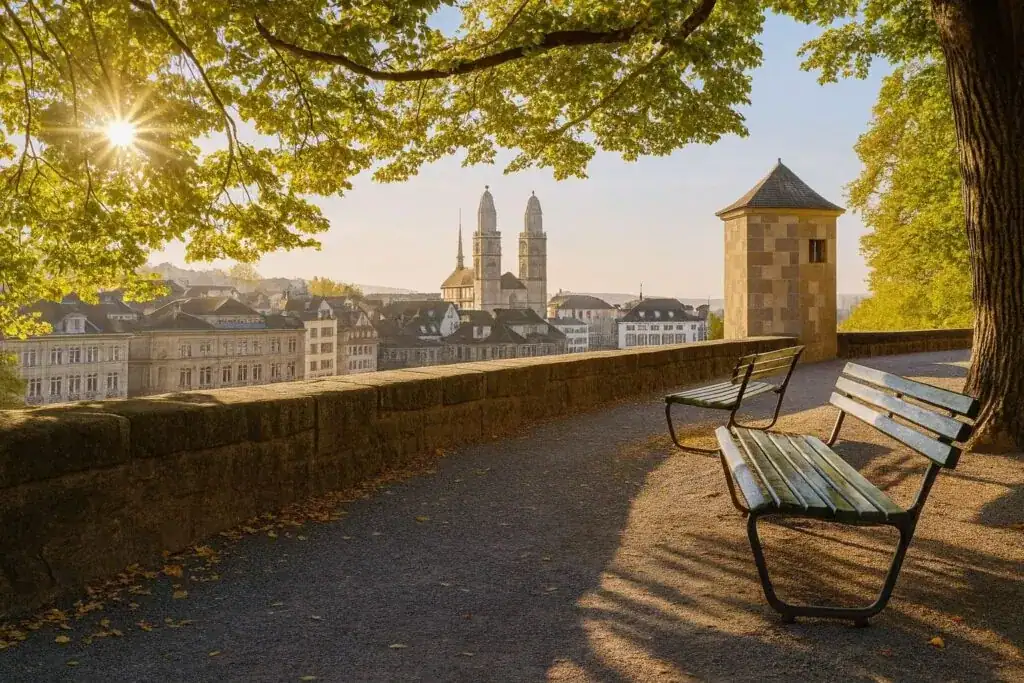
Lindenhof Location
St. Peter: a quiet square and Europe-scale clock hands
Head south to St. Peter. The church façade is modest, but its clock faces are famous: each dial measures 8.7 m across—often cited among Europe’s largest on a church. The square around it is a peaceful pause between viewpoints and riverfront alleys.
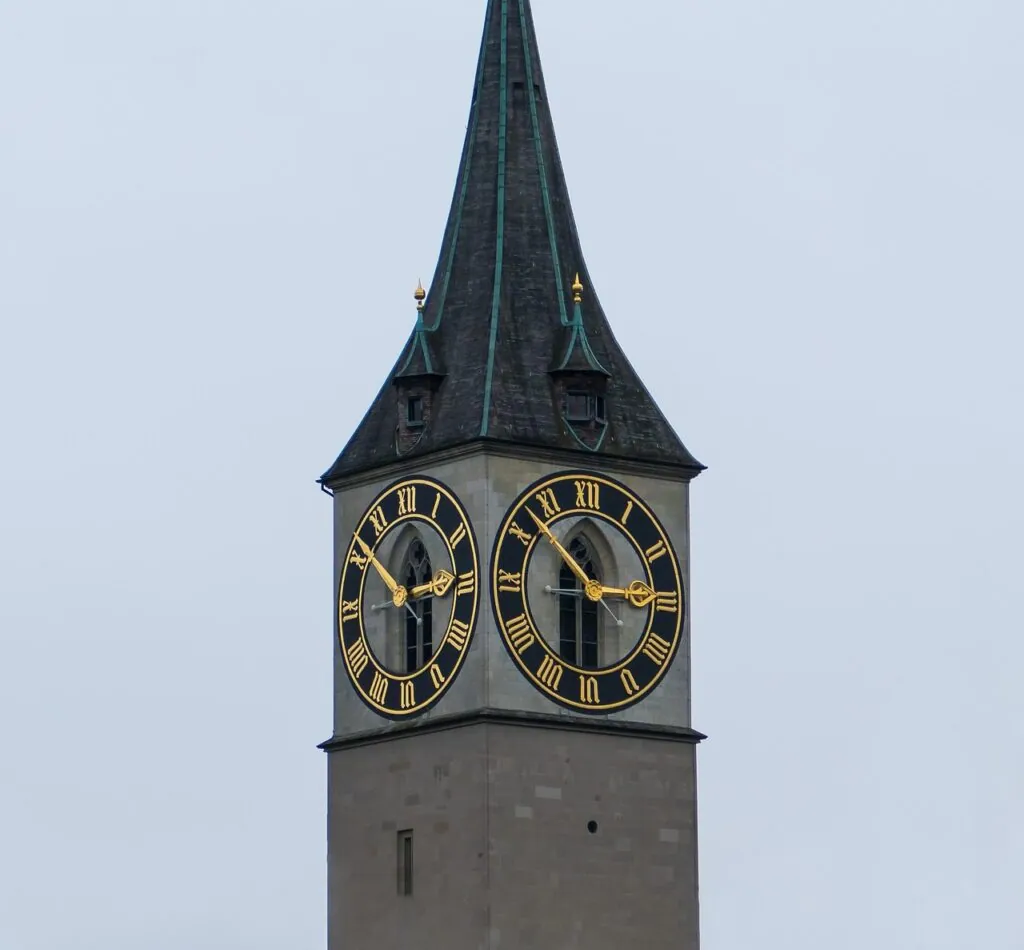
St. Peter Church Location
Fraumünster: Chagall’s stained glass that glows like music
Walk a minute to Fraumünster. Inside the choir, Marc Chagall’s five windows (completed 1970) flood the space with deep blues and reds; a rose window (added 1978) orbits Genesis motifs around Noah’s Ark. It’s the single most moving burst of color in the Altstadt—unmissable even if you have only one day. For hours and background straight from the source, see the church’s page.
Short takeaway: if you came for stained glass, Fraumünster is your must-see, and it sits steps from the river bridge you’ll cross next.
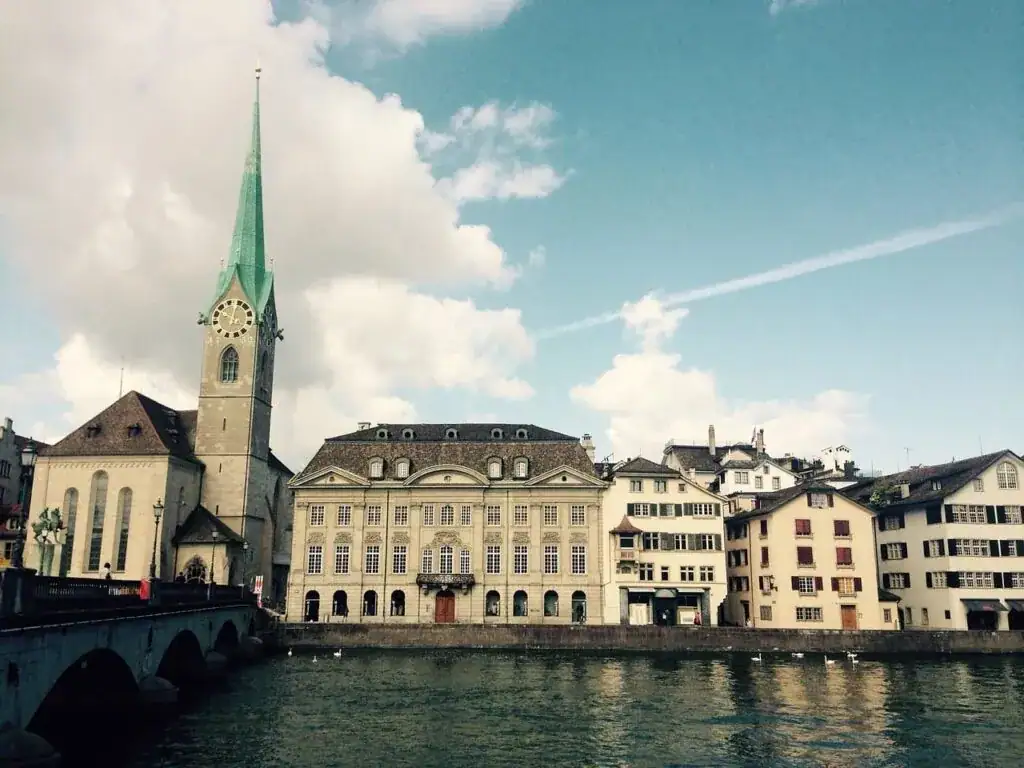
Fraumünster Location
Grossmünster: towers, river light, and modern glass by Sigmar Polke
Cross Münsterbrücke to the twin-towered Grossmünster, the city’s Romanesque landmark. Inside, look for the Sigmar Polke windows (installed 2009): some are made from slices of agate that glow with a geological shimmer when the sun hits. If you have the energy, climb the Karlsturm for views over rooftops and lake.
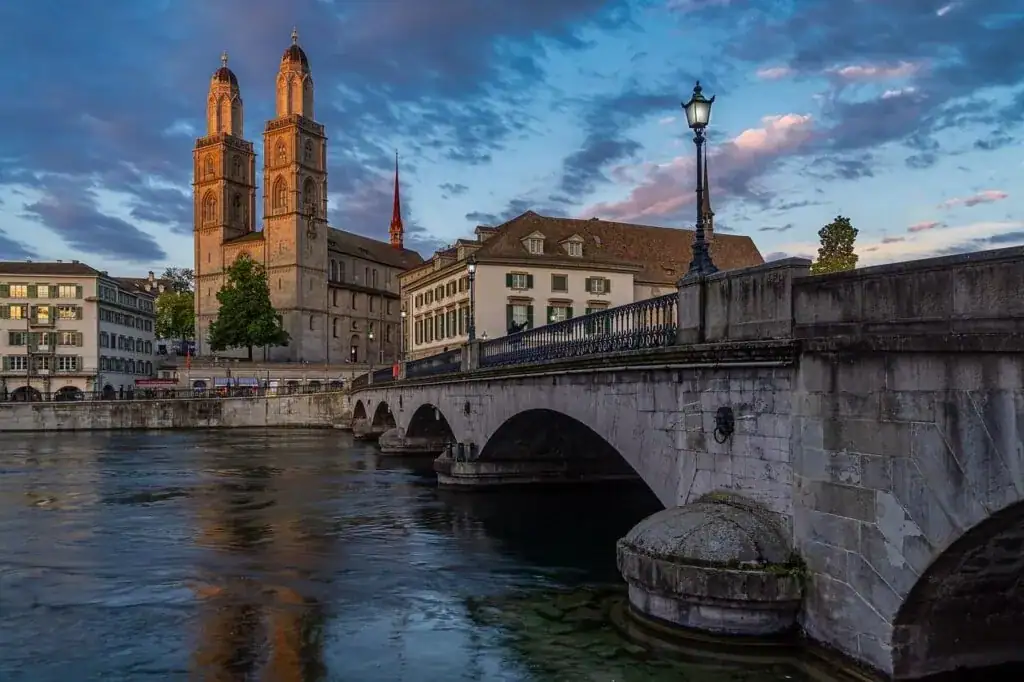
Grossmünster Location
Niederdorf & Oberdorf: lanes, cafés, and a spark of Dada
Now drift through Niederdorf (right bank). It’s the Altstadt’s most walkable maze: tiny boutiques by day, lively bars and restaurants by night. On Spiegelgasse, step into Cabaret Voltaire, the 1916 birthplace of Dada—still hosting shows and exhibitions that play with the rules, just like it did in wartime Zurich.
If you prefer art in a calmer room, continue to Helmhaus, the city-run contemporary art space by the river’s edge. Shows rotate, admission is typically free, and the arches frame the water beautifully.
Rathaus & Limmatquai: a town hall built over the water
As you follow Limmatquai, the Rathaus (Town Hall) appears like a stone ship on the river. The present building dates 1694–1698 and famously sits on a platform over the Limmat. From Münsterbrücke, you can see how the structure almost floats.
A few steps away, Helmhaus anchors the small square with arches that open toward the water, often hosting local artists—worth a five-minute look, even on a tight schedule.
Schipfe: riverside calm below the hill
Drop down to Schipfe, one of Zurich’s oldest quarters, tucked between the river and the Lindenhof slope. In the Middle Ages this was a working waterfront—boatbuilding, bathhouses, silk—and today it’s a pocket of artisan shops and calm benches where the city slows down.
Stained glass, part two: Giacometti & hidden flowers
If color on stone is your thing, note one more gem just beyond Bahnhofstrasse: the Giacometti Frescoes (the “Blüemlihalle”) in the entrance hall of the city police building. Visits run in short guided windows mid-week; it’s a quick, atmospheric stop if the timing suits.
Lake Zurich & Opera House: end by the water with a flourish
From the Old Town it’s a gentle stroll to Quaibrücke and the lake breeze at Bürkliplatz. Turn left and you’ll reach Sechseläutenplatz and the opera house—a grand, 1891 theatre that anchors the square and lights up at night. Even if you’re not seeing a performance, the steps are a classic place to rest your feet and watch trams glide by.
People also ask
Is Zurich Old Town walkable in one day?
Yes. The core sights sit within a compact area on both riverbanks. Start at Zürich HB, loop Lindenhof → St. Peter → Fraumünster → Grossmünster → Niederdorf → Rathaus → lake → opera house, and you’ll cover the essentials at an easy pace.
Where can I see stained glass in the Old Town?
For the classic experience, Fraumünster (Chagall, plus a rose window) and Grossmünster (Sigmar Polke’s modern windows). Both are minutes apart across Münsterbrücke.
A sweet detour (for the “chocolate factory” keyword you keep seeing)
There is no working chocolate factory inside the Old Town. If you want the full museum-plus-fountain experience, the Lindt Home of Chocolate is in Kilchberg, a short S-Bahn or boat ride away from Bürkliplatz—easy to add before dinner.
Mini-itinerary you can follow without a map
Morning: station → Lindenhof view → St. Peter → Fraumünster.
Midday: cross to Grossmünster (tower climb if clear) → lunch in Niederdorf.
Afternoon: Limmatquai → Rathaus → Helmhaus → benches at Schipfe.
Golden hour: lakefront at Quaibrücke → Sechseläutenplatz & opera house.
Prefer fewer crowds? Do the same loop before 10:00 or after 16:00; churches and lanes feel calmer, and the light is softer on the stone.
Practice makes perfect: tiny stories to copy on your own day
You step onto Lindenhof as the bells at St. Peter mark the hour. A street musician scales a Bach prelude; below, the Limmat throws sunlight onto timbered facades. Ten minutes later you’re in Fraumünster, and the first blue of a Chagall pane washes the pews like water. After a slow lunch in Niederdorf, you drift to Schipfe, where a woodworker sands a bowl in the doorway. At sunset you cross Quaibrücke, the lake pink in the wind, and sit on the opera steps as the square turns to a golden mirror.
FAQ
How much time do I need for the Old Town?
Three to five hours works for a focused first pass; add another hour if you climb Grossmünster’s tower or linger on the lake steps.
Are church interiors always open?
Open hours vary; services and concerts can limit access. Fraumünster and Grossmünster publish schedules and note occasional closures; check on the day if the windows are a must for you.
What’s special about St. Peter’s clock?
Each dial is 8.7 m wide—one of Europe’s largest church clock faces—so it’s your best timekeeper as you walk.
Is the Rathaus worth a stop inside?
Even a quick look from Münsterbrücke is interesting: the 17th-century town hall sits over the water on the Limmat, a rare sight.
Can I squeeze in a chocolate “factory”?
Yes—head to Lindt Home of Chocolate in nearby Kilchberg; it’s outside the Old Town but close, with trains and boats from the center.
What about modern art in the Old Town?
Drop into Helmhaus by the river; it’s city-run and focuses on contemporary work, often with free entry.
The takeaway
what to see in zurich old town: start at Lindenhof for a Roman-roots view, circle past St. Peter, Fraumünster (Chagall windows), and Grossmünster (Polke glass), then wander Niederdorf, Schipfe, and the Rathaus along Limmatquai before finishing by the lake at the opera house. It’s walkable in a day, filled with stained-glass color, river light, and easy café stops.