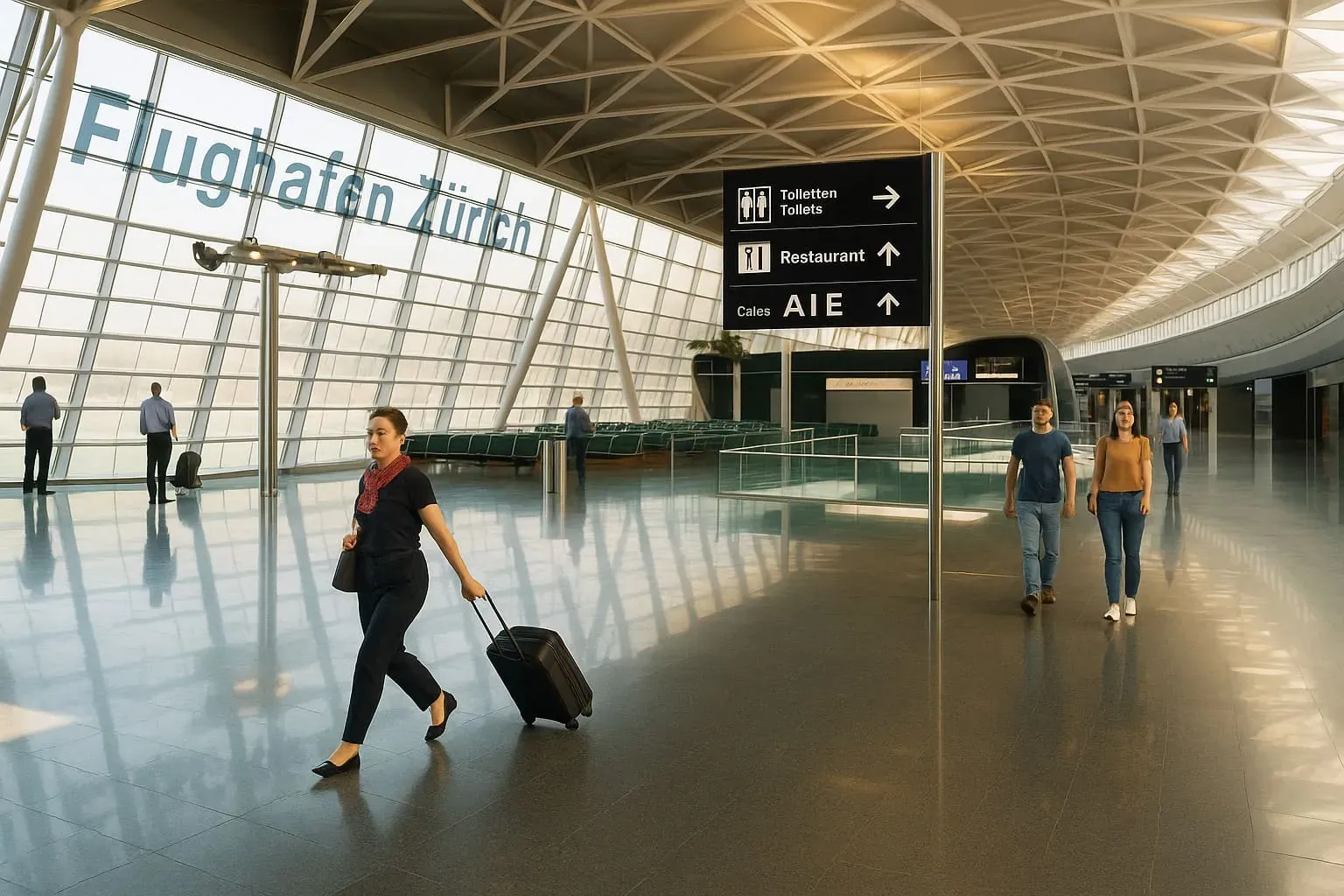
Zurich Airport covers about 953 hectares — roughly 9.5 km² — and has three runways. In 2025 it handled a record 32.6 million passengers across 270,116 take-offs and landings. That makes it Switzerland's largest airport by a wide margin, and a mid-sized hub by European standards. Around half the site is green space.
Zurich Airport in numbers
| Measure | Figure |
|---|---|
| Site area | 953 ha (≈ 9.5 km²) |
| Runways | 3 |
| Passengers, 2025 | 32.6 million (record, +4.5%) |
| Take-offs and landings, 2025 | 270,116 (+3.5%) |
| Air freight, 2025 | 440,930 tonnes (+1.1%) |
| Passenger docks | A, B/D and E |
The 2025 total is the highest in the airport's history — it finally passed the pre-pandemic peak set in 2019. Note that passenger numbers grew faster than flight numbers: 4.5% against 3.5%. Airlines are flying bigger aircraft and filling more of the seats, not adding proportionally more flights.
Is 953 hectares actually big?
For a European hub, Zurich sits in the middle. Amsterdam Schiphol covers roughly 2,800 hectares and Paris Charles de Gaulle about 3,200 — both more than three times the size. Zurich is far larger than any other Swiss airport, but it isn't in the same class as the continent's biggest.
The area figure also flatters the built-up part. Around half of those 953 hectares is grassland and protected habitat inside the airport perimeter, not concrete. Some of it is a nature reserve: the grass strips between runways are managed as dry meadow and mown on a schedule set for the plants, not for the aircraft.
Passenger volume tells a different story from area. At 32.6 million a year, Zurich handles more people than its footprint suggests, because the terminal is stacked vertically and the docks radiate from a single core. Compare that with Schiphol, which spreads roughly 80 million passengers across three times the land.
The practical consequence: Zurich rarely has the long inter-terminal treks that make big hubs stressful, but it does fill up. Peak mornings between 06:00 and 08:00 see queues at security that a mid-afternoon arrival never encounters.
The three runways, and the two being extended
| Runway | Length today | Approved extension |
|---|---|---|
| 16/34 | 3,700 m | — |
| 14/32 | 3,300 m | 3,580 m |
| 10/28 | 2,500 m | 2,900 m |
Voters in the Canton of Zurich approved the two extensions on safety grounds rather than to grow capacity. Longer runs give aircraft more margin in poor weather and reduce the number of go-arounds. Neither extension adds a new runway, so the airport's footprint stays as it is.
What the size feels like when you land
Smaller than the numbers suggest. Zurich Airport is built as one terminal complex with three docks rather than separate terminals scattered across a site, so you rarely walk more than about ten minutes from gate to baggage reclaim.
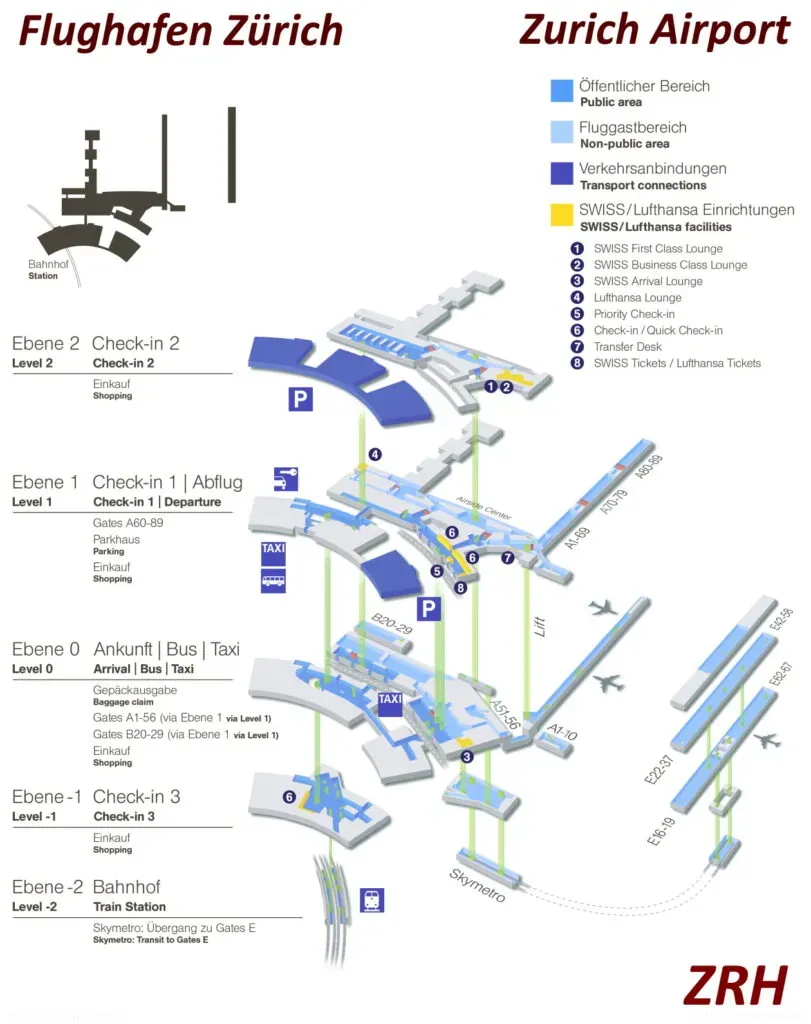
The exception is Dock E, which sits on the far side of the airfield between the two longest runways. You reach it on the Skymetro, an underground shuttle that takes about two minutes and runs every 90 seconds or so. Long-haul flights usually go from there, so if your boarding pass says E, budget an extra ten minutes.
Docks A and B/D sit inside the main building. A is the Schengen dock, B/D handles both Schengen and non-Schengen by switching the passport control lanes depending on the flight — an unusual arrangement that saves a whole pier's worth of space. It's one reason a 953-hectare airport can move 32.6 million people.
Getting around the site on the ground
Everything a passenger needs sits within one connected complex: check-in, both dock wings, the railway station, the bus terminal, the car parks and The Circle, the office and hotel development attached to the terminal. You can walk between all of them under cover.
That matters in winter. Zurich gets snow and freezing rain in January and February, and an airport built as separate terminals would mean shuttle buses in it. Here you stay inside from the train platform to the gate, which is a bigger practical advantage than the raw size numbers suggest. If you're arriving in the cold months, our guide to what to wear in Zurich covers the layers that actually work.
The station under the terminal also means the airport doubles as a long-distance hub. Direct trains run to Bern, Basel, Lucerne and — since June 2026 — straight to Interlaken, so plenty of arrivals never set foot in Zurich city at all.
How long do connections take?
The official minimum connection time is 40 minutes, and that is realistic here in a way it isn't at larger hubs. Everything sits under one roof, passport control is quick, and the docks are linked airside. Swiss, which runs the largest share of the connecting traffic, schedules a good part of its network around that window.
If you're connecting to a train rather than a flight, the station is directly beneath the terminal — one escalator down from arrivals, no shuttle. Our guide to getting from Zurich Airport into the city covers the timings.
People also ask
Is Zurich Airport big for a Swiss airport?
Yes. Zurich Airport is Switzerland's biggest by far in both area and traffic, serving as the main hub for Swiss and its partner airlines. Geneva, the country's second airport, handles roughly half the passengers on a much smaller site.
How many runways does Zurich Airport have and how long are they?
Three. Today they measure about 3,700 m (16/34), 3,300 m (14/32) and 2,500 m (10/28), with approved extensions to 3,580 m for runway 32 and 2,900 m for runway 28.
How big is Zurich Airport in hectares or km²?
Roughly 953 hectares, or about 9.5 km², including substantial green and conservation areas inside the perimeter. Around half the site is not built on at all.
Is Zurich Airport the biggest airport in Europe?
No. Zurich Airport is a mid-sized European hub — large enough for long-haul reach and short connections, but smaller than the very largest. Schiphol and Charles de Gaulle each cover more than three times the area.
How does Dock E change the feel of the airport's size?
Dock E sits between the two longest runways and is reached by the Skymetro shuttle. Dock E expands capacity without making the main building bigger, which is why the airport handles 32.6 million passengers while still feeling walkable.
The short version
953 hectares, three runways, 32.6 million passengers in 2025. Big enough to be Switzerland's main gateway and reach every continent directly, compact enough that a 40-minute connection genuinely works. Half the site is grass.
Traffic figures for calendar year 2025, published by Flughafen Zürich AG. Checked September 2026.